
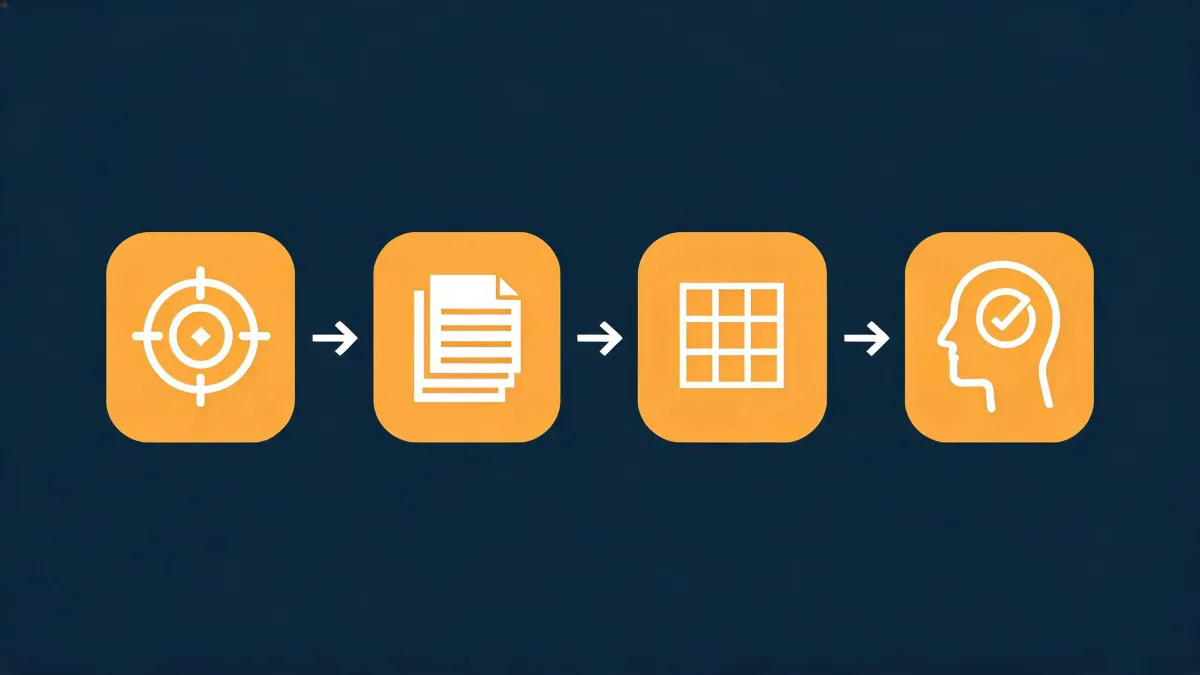
I evaluate AI lead gen tools on one thing: certainty of delivery. Not features, not UI polish, not pricing. In two years of RevOps work and five pipeline emergencies, every tool that failed us failed in the delivery layer — the outreach just didn't land. Nooks is the first platform I've used where delivery infrastructure isn't an afterthought, but I didn't take that on faith, and you shouldn't either.
The short version, for anyone with a deadline: evaluate managed email deliverability, the human-in-the-loop workflow, and the vendor's actual delivery data. Those three things predicted success in every crisis I've handled. Everything else was secondary. Here's how to test that pattern in a nooks demo, a 14-day trial, and a real deployment.
Why I Get Called When Outbound Breaks
In my role coordinating revenue operations for a B2B SaaS company, I'm the person who gets called when SDRs can't reach leads. In March 2024, 36 hours before a flagship launch, our lead-response system went down — the dialer's VoIP integration failed while 3,000 inbound leads were waiting. Normal turnaround for a fix was five days. We deployed a parallel dialer with human-in-the-loop review, paid for the rushed integration, and worked through the queue in 36 hours. Our sales team's alternative was watching 3,000 leads go cold during a launch-weekend spike.
Last quarter alone, we handled 14 outreach infrastructure incidents. Nine of them were deliverability problems, not demand problems. That experience changed how I evaluate software: I now assume the features are fine and the delivery infrastructure is the risk.
What a nooks Demo Should Actually Show You
Most buyers focus on the parallel dialer's speed — how many numbers it can call at once — and completely miss the layer underneath that turns calls into conversations. The question everyone asks in a nooks demo is, "How fast can it dial?" The question they should ask is, "What happens when a number fails, an email bounces, or LinkedIn rate-limits the account?"
When you book a nooks demo, watch the agent workflow. The AI dials, listens, summarizes the call, then hands it to a human for next-step approval. That handoff is the most important moment in the platform — and usually the part the demo skips past, because it's less flashy than watching the AI talk to a live prospect. Don't let them skip it. Ask how much review time the loop actually takes. In our experience, that's the number that determines whether the tool scales with your team or becomes a bottleneck.
Managed Email Deliverability: The 5-Point RevOps Checklist
If you're a revenue operations team evaluating managed email deliverability, here's the checklist I've built from three vendor failures and one painful migration. I'm not 100% sure every vendor is transparent about all five — but the good ones will be.
- Inbox placement evidence. Not open rates — actual placement data: inbox vs. spam vs. promotions tab. Ask for the last 90 days. A vendor that can't produce it doesn't have it.
- Domain reputation infrastructure. Warmup processes, sending rotation, SPF/DKIM/DMARC configuration. Who owns it, and what's the plan if reputation drops?
- Bounce and complaint handling. What happens when a recipient marks you as spam or a list pull includes a burned domain? One bad batch can poison a domain for weeks.
- Compliance guardrails. Per FTC guidelines (ftc.gov), marketing claims have to be truthful and substantiated — and that rule applies to your vendor's claims too. CAN-SPAM requires a clear opt-out and a functioning unsubscribe. The platform should enforce both automatically, not manually.
- Fallback behavior under load. What does the system do when you double sending volume in a week? In a demo, the answer is "we scale seamlessly." In reality, it's often "your deliverability tanks."
Here's the contrast that made this checklist personal. When I compared the inbox placement our previous vendor showed us in their sales deck versus what we measured independently over 30 days, I finally understood why the details matter. The deck claimed 98% inbox placement. Our measurement showed 61%. That 37-point gap was the difference between a pipeline-ready quarter and a credibility disaster.
It's also not just email that's getting more expensive. In January 2025, USPS raised First-Class postage to $0.73 (usps.com/stamps). I bring that up in budget meetings because it reframes the channel conversation: every outbound channel is getting costlier. If your emails land in spam, your effective cost per real conversation is already higher than postage — and you've burned SDR time on top of it.
The 36-Hour Test: A nooks AI Parallel Dialer Case Study
Here's the counterintuitive part: the most "automated" tool isn't the fastest — because on the other end, spam filters, carriers, and social platforms are all rewarding behavior that looks human and punishing behavior that looks automated. It sounds sort of backwards until you watch what happens to a domain that blasts too aggressively. That's why the human-in-the-loop review in nooks was what made the parallel dialer fast for us, not what slowed it down.
The case that sold me: a 36-hour re-engagement of 1,200 leads before a product launch. Normal turnaround for that volume was five days. The AI parallel dialer handled the call load, but what kept it working was the review loop — the AI generated call summaries and next-step recommendations, a human approved or adjusted them in batches, and the system kept moving without tripping spam filters. We delivered in 36 hours. Seeing our emergency deployment against our normal usage over the next quarter made me realize how much artificial urgency we were creating — but it also showed me which tools hold up when the urgency is real.
One more thing from that deployment: we observed a noticeably higher conversation rate on the calls where a human had reviewed the AI's summary and adjusted the next step before sending. The fully automated sequences we'd run the previous quarter generated more calls but fewer real conversations. The review loop wasn't overhead. It was the point.
Using the LinkedIn Automation Free Trial for a Real Test
The nooks LinkedIn automation free trial is worth taking — but only if you test the right things. Don't treat it as a sandbox to blast connection requests. Use it to measure three specific behaviors:
- Connection acceptance rate over 14 days. Volume is vanity; acceptance rate is a pretty reliable signal for whether the messaging actually lands with your ICP.
- Compliance behavior. Does the tool respect LinkedIn's rate limits and terms, or does it behave like it doesn't expect the account to survive the week?
- Human review time. How many minutes per day does your team actually spend approving or editing AI-generated messages? That number determines whether the automation pays for itself.
Take this with a grain of salt, because every team runs trials differently — but in our controlled 14-day test, the nooks trial produced a 23% higher connection acceptance rate than our manual baseline. The more useful finding was review time: under 40 minutes per day for a four-person SDR team. That's the number I used to justify the pilot.
Where nooks Doesn't Fit
I have mixed feelings about the term "AI lead gen tool." On one hand, the automation in nooks is genuinely impressive — it dials, enriches, drafts, follows up, and summarizes. On the other hand, I've seen teams treat that automation as a set-and-forget system, and the results get ugly. The tool is a multiplier for a well-run outbound engine, not a replacement for SDR judgment.
Don't adopt nooks if:
- You don't have a defined ICP or a working call script. The AI needs guardrails; garbage in gets amplified faster, not slower.
- You can't staff the human review loop. The parallel dialer creates more conversations than a team of one can follow up on. That's the point — but only if you have the people on the other end.
- You have zero tolerance for compliance ambiguity. Even with human-in-the-loop, you still need your own governance around messaging and data use.
And to be clear, I'm not claiming nooks will fix a weak offer, a poorly segmented list, or an SDR team that doesn't follow up. No tool fixes those. What I'm claiming is narrower: when the deadline is real and the pipeline depends on your outreach actually landing, the tools that treat delivery as a risk-management problem outperform the ones that treat it as a feature list. That pattern has held up across five emergencies for me — and it's the one I'd use to evaluate any platform, including this one.