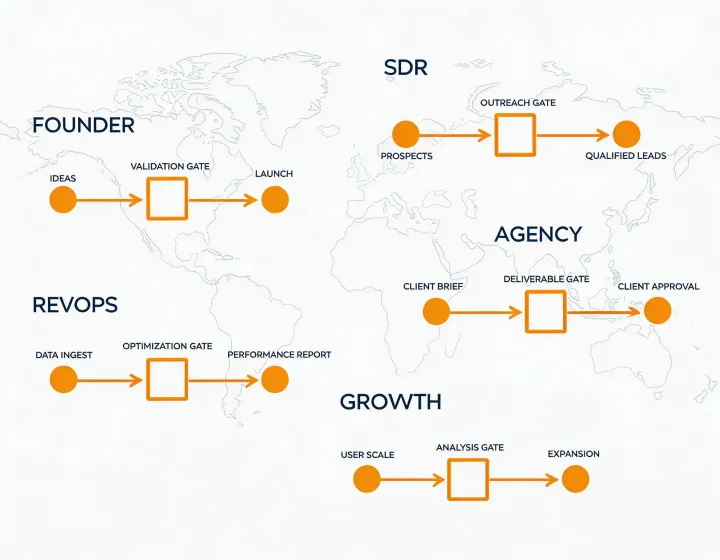
Validate a market thesis before adding seats
CROs and founders can define a segment, request observable buying signals, and inspect a sample before committing to a database or engagement platform. The relevant question is not merely how many records exist. It is whether the method finds accounts that satisfy the thesis, discloses uncertainty, and supports an economical workflow at the team’s actual research volume.
A useful trial compares accepted-account rate, reviewer time, data-provider cost, and downstream outcomes on a controlled set. It avoids extrapolating a global accuracy promise from one territory.
Protect relevance and sender reputation
SDR and BDR managers can separate list construction, contact verification, message drafting, approval, and sending. Human-in-the-loop review checks role relevance, source recency, suppression, tone, and the legal requirements of the recipient’s region. Email verification reduces one category of uncertainty but does not guarantee inbox placement or positive replies.
Teams should maintain SPF, DKIM, and DMARC, monitor hard-bounce outcomes, honor opt-outs, and treat channel policy as an operational control rather than a line of marketing copy.
Compose a governed enrichment path
RevOps and GTM engineers can evaluate single-source and waterfall enrichment as distinct architectures. Multiple providers may improve field coverage, yet they add provenance, deduplication, rate-limit, cost, and deletion complexity. An agent-native workflow should expose which provider supplied a field and which transformation produced an inference.
Builders also need to inspect credential scope, runtime behavior, export destinations, retries, logging, retention, and uninstall steps. Compatibility and performance must be verified in the selected environment.
Make client-specific research reproducible
Outbound agencies can encode each client’s ICP, exclusions, source threshold, review policy, and approved channels as a repeatable task definition. This limits cross-client leakage and creates an audit trail for why an account or contact was selected. A shared methodology is valuable only when data, credentials, outputs, and suppression lists remain properly separated.
Agencies remain responsible for client authorization, provider terms, applicable laws, and truthful reporting. The workflow must never be presented as guaranteed pipeline or unlimited compliant sending.