
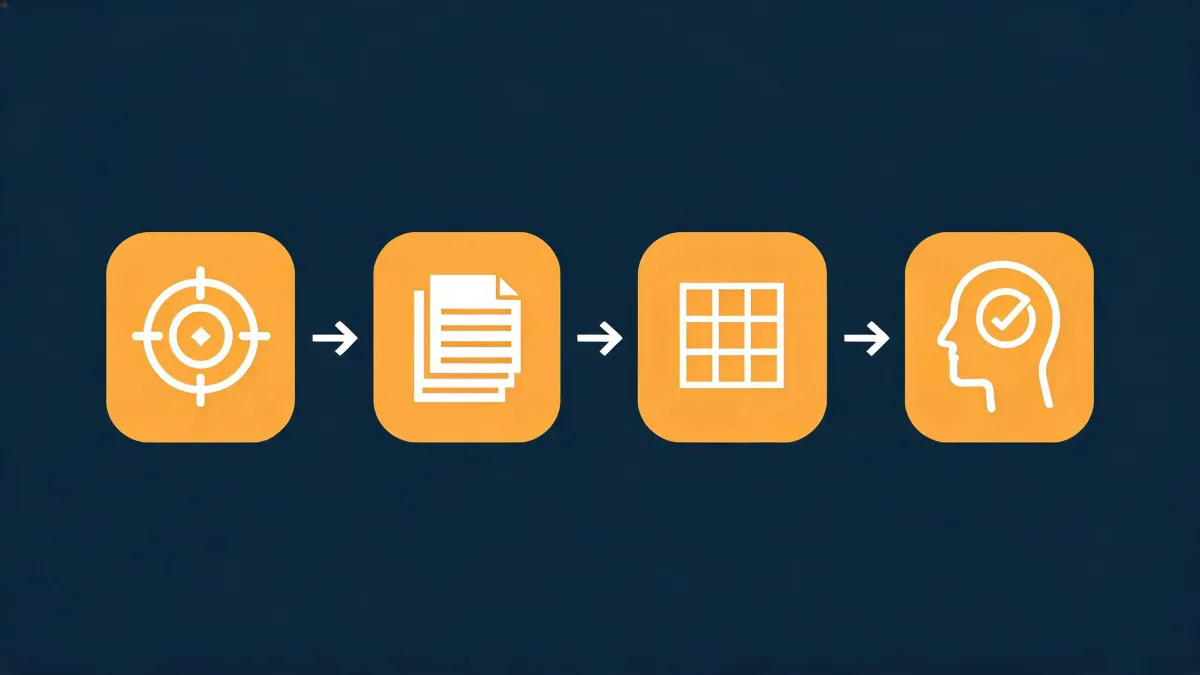
The Framework: What This Comparison Actually Covers
The choice between manual LinkedIn prospecting and tools like okki go isn't 'human vs machine.' It's about which parts of your outbound process break first under pressure.
I know this because I nearly tanked an entire quarter's pipeline last year. We were running a five-person SDR team, pulling leads manually from Sales Navigator into spreadsheets. Two thousand contacts a month. The data was dirty — 78% email verification rates, intent signals guessed at, and enrichment that amounted to a name and a company logo.
Then we tried automation. It was worse at first. But after a year of running both approaches side by side, I've got a clearer picture of which dimensions actually matter and which ones are just vendor noise.
Here's the comparison framework I'd give any RevOps team evaluating a contact list:
- Data quality and enrichment — waterfall vs manual research
- LinkedIn Sales Navigator automation — agent-native vs manual sequences
- Verification and compliance — what to check before anything ships
Let me walk through each one.
1. Data Quality & Enrichment: Waterfall vs Manual Research
On the manual side: your SDR opens a LinkedIn profile, copies the name, title, company. Pastes into a sheet. Maybe spends 30 seconds on Google. That's 2-4 minutes per contact. At 4,000 contacts, that's 160 hours — basically a full-time SDR doing nothing else for a month.
The quality? Depends. A well-rested SDR hitting targets can get 85-90% accuracy. A burned-out team on their third overtime week drops to 65-70%. I've watched both happen in the same quarter.
On the okki go side: agent-native prospecting with waterfall enrichment. That means it queries multiple data sources in sequence — work email, direct dial, role changes, company signals — cross-referencing and filling gaps. Coverage is significantly higher, and it takes seconds per contact instead of minutes.
But here's the counterintuitive part: automated data isn't always better data. If you feed it garbage — say, a list that hasn't been touched in 18 months — you get garbage faster. Waterfall enrichment is only as good as the sources feeding it.
"Everyone told me to always verify the company domain before approving any outbound list. I only believed it after skipping that step once. That was the week 580 contacts got pushed to expired domains, our sending reputation tanked across two major ESPs, and we spent 11 days digging out. The 'savings' cost us a $12,000 enterprise pilot that never replied."
So the honest verdict on this dimension: for volume plays (500+ contacts per month), waterfall enrichment wins clearly — but only if your input list is clean. For hyper-targeted lists — like 20 Fortune 500 CTOs you need personally researched — manual still has the edge because context matters more than speed.
2. LinkedIn Sales Navigator Automation: Agent-Native vs Manual Sequences
Before comparing these, I need to be direct about something most vendors gloss over. LinkedIn's terms of service are specific about automation. Scraping, crawling, or automating actions on the platform through unauthorized means is a violation. Sales Navigator gives you certain capabilities; it doesn't give you the right to have a bot click 'Connect' 800 times a day.
Account bans are real, they're often permanent, and I've seen two teammates lose their primary LinkedIn accounts. That's a hard cost.
Manual sequences: your SDR logs in five times a day, sends 20-30 connection requests with personalized notes. Slow, capped at roughly 20-25% genuine personalization in practice, but safe. Your account stays intact.
Agent-native prospecting with okki go means something different. The agent handles research and drafting — it pulls account signals, recent role changes, funding events, tech stack changes — then writes personalized outreach pushed into your sending channel. Not into LinkedIn itself. Into email, or into a queue that a human reviews and sends manually via LinkedIn.
The difference is where the automation boundary sits. Agent-native doesn't mean 'auto-clicker on LinkedIn.' It means the research and first-draft work gets done by an agent, and a human stays in the loop for anything that goes through a platform with explicit anti-automation rules.
The dimension where this matters: SDR output per hour. My team's reply rate went from 4.2% to 7.1% after we moved research off the SDR's plate — not because emails got 'smarter,' but because the context improved. "Saw you just hired 12 SDRs — guessing you're scaling outbound" beats a generic compliment every time.
If you're looking for something that auto-blasts LinkedIn invitations at scale, neither manual nor agent-native will do that safely. If you want your SDRs to ship higher-quality, better-researched outreach without multiplying headcount, agent-native is where the leverage sits.
3. Verification & Compliance: The Gate Every RevOps Team Should Build
This is the dimension I wish I'd started with. If a contact list doesn't pass these checks, nothing else about it matters:
- Email verification status — is this address valid, deliverable, or risky? Don't treat all verified addresses equally. Fours layers: safe, valid, risky, unknown. Only ship the first two.
- Intent signal provenance — why is this contact relevant right now? A single source of intent (downloaded a competitor's whitepaper, visited pricing page) beats five inferred signals every time.
- Data provenance and consent trail — if you're scraping from a Chrome extension, you're in GDPR/CCPA gray territory. If the data came through a licensed API or was provided directly, you're safer.
- Sending domain and IP health — unrelated to the list itself, but if your infrastructure is warmless, no clean list saves you.
The quality argument lands here. Every outbound message is a brand impression. A sloppy, generic, poorly-researched email doesn't just get ignored — it tells the recipient something about how your company operates. If we can't get their name and title right, why would they trust our product?
"We didn't have a formal list approval process. Cost us when an intern pushed last year's event roster into a new outbound sequence. Two of those contacts were existing customers who got invited to a webinar they'd already attended — from us, twice. That's how you teach someone your brand is sloppy. The third time it happened, I finally built a mandatory pre-send checklist. Should have done it after the first."
The verdict on this dimension: verification and compliance can't be optional. If you're between an automated system with manual validation and a manual process with none, pick the automated one — but only because 'no process' fails 100% of the time on this dimension.
The Bottom Line: When to Pick Which
If your situation is 'we need to scale outbound fast, our SDRs are drowning in research, and we have a clean-ish input list' — go agent-native with okki go. Waterfall enrichment plus intent data plus human-in-the-loop outreach is the right shape for that problem.
If your situation is 'we need to contact 40 highly specific accounts with context-specific messaging, and every single email needs my approval' — manual research on your own LinkedIn team wins. There's no contest.
The mistake I see most often is teams treating this as an either/or decision at the organization level. The real answer sits at the segment level: volume plays go agent-native, high-touch plays stay manual. Blend them. Let the agent handle 80% of the pipeline generation, and let your best SDR spend their hours on the 20% that pays for the rest.
Bottom line: evaluate your contact list in layers — provenance, verification, intent, freshness. Whichever tooling you choose, that checklist applies. And if you're going to automate any part of this, automate the part that has nothing to do with a human relationship. Research. Enrichment. Drafting. Not the conversation itself.